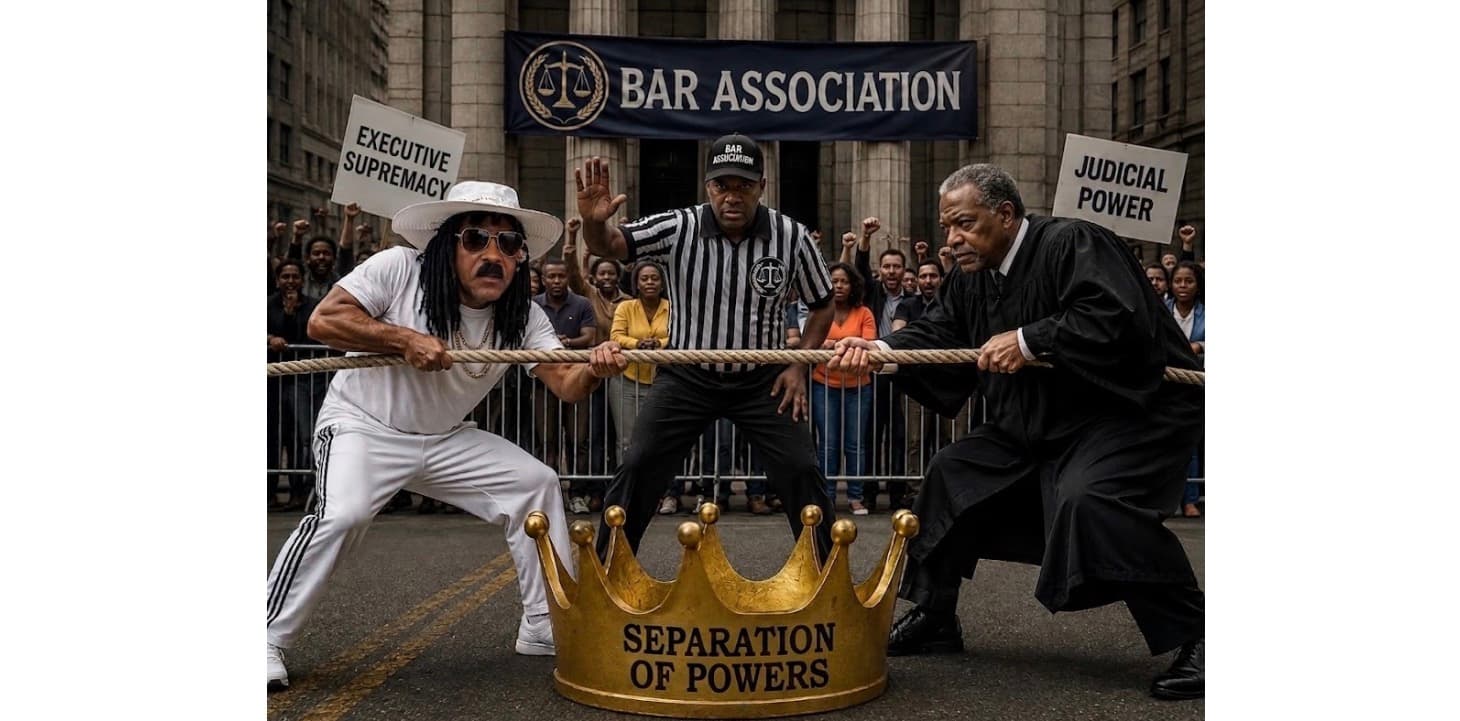
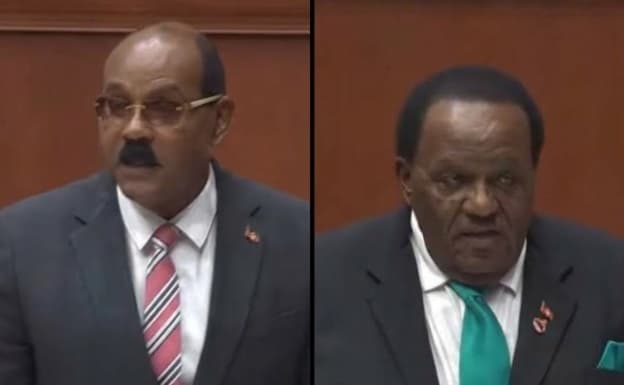
According to the Internet, last week, at a National Security meeting, Prime Minister Gaston Browne turned to an unnamed sitting judge and delivered this line: "Brother man, if you cannot follow the lead of parliament to give longer sentences, leave our country voluntarily otherwise we are going to deport you and make you persona non grata. You know who you are. This is the prime minister of the country saying this."
The Antigua and Barbuda Bar Association asked the PM to withdraw the threat and affirm that executive power would never be used to intimidate a judge over a lawful ruling and the petulant PM refused, called them "defunct" and told them to "Piss off". Whatever one makes of this puerile constitutional theatre, the Prime Minister’s tetchy performance is indefensible.
The episode rests on the PM’s visceral, misguided, half-baked belief that longer sentences deter crime. That claim is not controversial among criminologists. It is simply wrong, and it has been known to be wrong for over two hundred and fifty years.
An Instinct as Old as Fear, and as Useless
There is something understandable about the cognitive indolence that induced the Prime Minister support for this defunct theory. It requires no data, no patience, and no engagement with a single study. It requires only the conviction that fear scales with pain, that a fifteen-year sentence frightens a would-be gunman twice as much as a seven-year one, and that judges who decline to hand out the maximum are therefore complicit in the next shooting. It is the criminological equivalent of believing the earth is flat because it looks flat from your veranda. It feels true, but has never been true.
Cesare Beccaria demolished this instinct in 1764, writing that "one of the greatest curbs on crime is not the cruelty of punishments, but their infallibility … The certainty of punishment even if moderate will always make a stronger impression."
Jeremy Bentham reached the same conclusion. That was the eighteenth century, but he Prime Minister's understanding of criminal deterrence has, apparently, not yet caught up.
What Two and a Half Centuries of Evidence Actually Show
The modern research is not ambiguous, and it is not close. The United States National Institute of Justice's landmark synthesis states plainly that "the certainty of being caught is a vastly more powerful deterrent than the punishment" and that "increasing the severity of punishment does little to deter crime."
Daniel Nagin, who chaired the National Research Council's Committee on Deterrence and the Death Penalty and has spent a career studying exactly this question, found that support for certainty of apprehension is "far more convincing and consistent" than support for severity. Past a moderate baseline, adding years to a sentence buys essentially nothing.
Canada's leading scholars on the subject, Anthony Doob and Cheryl Marie Webster, reviewed the literature so thoroughly that they recommended criminologists simply accept the null hypothesis: sentence severity has no measurable differential effect on crime rates.
Even John A. Macdonald, Canada's first Prime Minister, a man not otherwise remembered as a bleeding-heart reformer understood in the nineteenth century that "certainty of punishment … is of more consequence in the prevention of crime than the severity of the sentence." One wonders whether Prime Minister Browne has read further into the subject than a few Facebook post allows.
Australia's evidence points the same way: the probability of arrest and conviction moves crime rates; expected sentence length barely does. The Australian Law Reform Commission has concluded outright that mandatory sentencing "is not effective as a crime deterrent."
England's Sentencing Council, reviewing the same terrain, found that "despite pervasive 'common sense intuitions', the evidence for a general deterrent effect related to sentence severity is weak," and that resources spent raising detection rates outperform resources spent lengthening already-substantial sentences.
None of this is exotic or foreign learning irrelevant to a small Caribbean nation. Our own region's scholars arrived at the identical conclusion. The University of the West Indies Faculty of Law's Centre for Criminology interviewed judges, prosecutors and defence practitioners across Trinidad and Tobago on mandatory sentencing and found the same theme surfacing again and again: it is the low conviction rate, not the sentence on the books, that offenders actually weigh - and without certainty of punishment, marginally harsher sentences are unlikely to deter any more than a slightly lighter sentence would.
Practitioners who work our own courts, in our own legal tradition, inheriting our own Caribbean jurisprudence, are telling the Prime Minister the same thing Beccaria told Europe in 1764. PM Browne has simply chosen superstition over centuries of empirical science.
The Man Who Earns Credit for Grandstanding, Not for Governing
Here is the part that should embarrass him most. Parliament already raised the maximum sentence for gun crimes to fifteen years; the Prime Minister's own government did that. Having passed the law, he now blames judges for not treating his own maximum as a minimum, and threatens to deport them for exercising the very discretion his own advisers reportedly told him not to legislate away. The Prime Minister has chosen not to confront the crime wave with policy based on science, but with a scapegoat, because a scapegoat is cheaper than detective work, cheaper than forensics labs, cheaper than clearing a case backlog, and infinitely more useful on Facebook than any of those things.
Ask the obvious question: if longer sentences deterred crime, why does Antigua and Barbuda need this conversation at all? The maximum was already raised. If severity were the lever, we should already be seeing the results. But we are not, so our feckless Prime Minister is touring the country hunting for judges to blame for his strategic incoherence.
Former prosecutor in Antigua turned St Kitts and Nevis DPP, Adlai Smith, has already said the quiet part out loud: judges follow sentencing guidelines, not press conferences, and if the guidelines need revisiting the proper venue is the Sentencing Council, not a National Security meeting turned into a public shaming of the bench. That is not a radical position. It is the position of someone who has actually worked inside the system the Prime Minister is threatening to gut.
What Would Actually Work
If the Prime Minister Browne really wanted to reduce gun crime, no need to throw a tantrum, the research tells him exactly where to spend the money: on detection, not deterrence theatre. Visible policing. Faster forensics. A functioning pipeline from arrest to conviction, so that the "approximately 250 repeat offenders" he cites are not simply repeat offenders because they were repeatedly released without ever being properly caught, charged and tried. Certainty is unglamorous. It does not produce as viral a soundbite as deporting a judge. It requires the much harder work of building institutional capacity rather than threatening the people who staff it.
There is a legitimate, serious conversation to be had in Antigua and Barbuda about sentencing guidelines, about judicial resourcing, about whether our courts are keeping pace with the crimes before them. The Prime Minister has chosen not to have that conversation. He has chosen instead to threaten a sitting judge with deportation on Facebook, insult the Bar Association's objection to that threat, and stake his entire theory of crime on an intuition that was already obsolete when Beccaria retired it in the eighteenth century.
Antigua and Barbuda deserves a PM that reads the evidence before he threatens the judiciary that applies it. Until then, we are governed by a PM with a theory of punishment that the rest of the democratic world abandoned. Antigua and Barbuda is simply reaping the consequences of electing a 60-year-old, mentally challenged out-patient, who performs on stage in a dreadlocks wig, and addresses a sitting judge as "brother man."