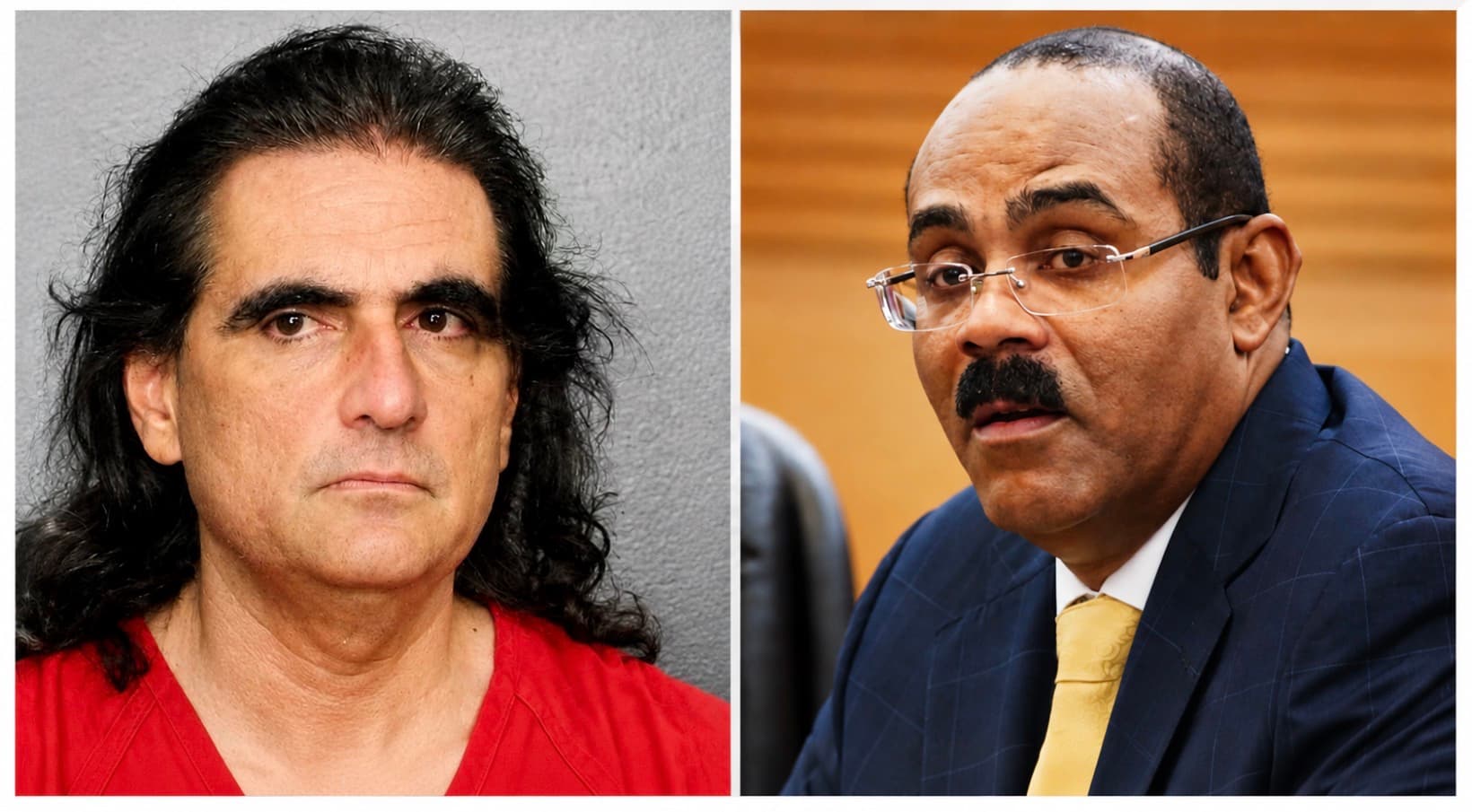
Alex Nain Saab Morán — the Colombian-born businessman to whom Prime Minister Gaston Browne gave an Antigua and Barbuda diplomatic passport and the title of Special Economic Envoy in November 2014 — has admitted in a United States federal court that he ran a near decade-long bribery and money-laundering conspiracy, and that his network used shell companies and bank accounts in Antigua to conceal the proceeds.
Saab, 54, pleaded guilty on Tuesday before US District Judge Kathleen M. Williams in Miami to a single count of money laundering tied to a bribery conspiracy, agreed to forfeit US$195 million in criminal proceeds, and committed to cooperating with continuing federal investigations, the Associated Press reported. Reversing the not-guilty plea he entered on July 24, Saab answered "Guilty, Your Honor" when the charge was put to him.
The offence carries a maximum of 20 years, but prosecutors agreed to recommend a sentence at the low end of the guidelines and to seek further reductions if his cooperation proves substantial. Bloomberg reported that sentencing is expected in January, although the US Department of Justice said a sentencing date has not been set.
For Antigua and Barbuda, the plea lands with particular force. In an eight-page statement of facts filed with the plea, Saab said he and his associates falsified shipping records and built a network of shell companies and bank accounts in countries including Antigua and Barbuda, Bulgaria, Liechtenstein, the Marshall Islands, Montenegro. The admission places this country's financial system inside a sworn criminal confession — not a blog post, not a leaked bank report, but a document Saab signed to secure his plea deal.
What Saab Admitted
According to the Justice Department, Saab carried out a nearly ten-year conspiracy to profit corruptly from the Venezuelan food-and-medicine welfare programme known as CLAP, organising bribes and other illegal payments to public officials so that entities secretly controlled by the conspirators would win lucrative import contracts. The conspirators then failed to deliver in full, using fake companies, false invoices and false shipping records to skim hundreds of millions of dollars.
Saab admitted skimming at least US$195 million from at least six contracts awarded to companies he controlled, and said the scheme enjoyed "the approval, participation and protection" of some of Venezuela's highest-ranking officials — including one identified only as "Government Official 1A," who designated a surrogate, one of four unnamed co-defendants, to receive bribes. Former Governor José Gregorio Vielma Mora allegedly received US$17 million in kickbacks after secretly awarding a Saab-controlled company a 2016 contract to deliver 10 million food boxes in Táchira state. As US sanctions tightened, Saab and his associates were paid in Venezuelan oil, gold and other natural resources.
US Attorney Jason A. Reding Quiñones said his office built a new case and secured a fresh indictment in January 2026 after President Biden's December 2023 clemency. US Attorney Quiñones further stated the plea shows that political connections, wealth and proximity to a corrupt regime "will not put anyone beyond the reach of American justice." Assistant Attorney General A. Tysen Duva said Saab built "a complex web of front companies, shell accounts, and false records", Al Jazeera reported.
Axios noted that the plea could strengthen the separate US prosecution of Nicolás Maduro himself, who is awaiting trial in New York. US officials have long described Saab as Maduro's "bag man" and could call him as a witness against the former president, who was captured in a US military raid in January.
The Antigua Connection: a Passport, a Diplomatic Title and a Factory that Never Came
Alex Saab's Antigua and Barbuda diplomatic passport was issued on 18 November 2014, less than six months after the Browne administration took office. According to a 2019 Bloomberg investigative report, PM Browne invited Saab to become special economic envoy to Venezuela, granting him Antiguan citizenship, with a contract to build a factory in Antigua to make housing panels — a factory that never opened. The Bloomberg feature by Michael Smith, as summarised by the Daily Observer at the time, reported that US investigators considered Saab "one of the most powerful financial enablers of Maduro's regime," that he never kept his promise to build the panel factory here — though he built one in Venezuela — and that PM Browne described him as a friend.
The Prime Minister's own account fleshes out the arrangement. PM Browne told the Observer that Saab was brought into a proposed trade arrangement with Venezuela and was expected to participate in a major housing development; that then-minister Michael Browne travelled to Venezuela to inspect Saab's housing operation and reported positively to Cabinet; that the government made roughly 100 acres of land available; and that roads were cut and several two-storey houses built before the project stalled. PM Browne said that after Saab ran into trouble with the United States, the Antiguan government revoked his citizenship and took back the land.
That last claim sits awkwardly beside the government's 2019 position. Foreign Minister Chet Greene told the Observer in April 2019 that Saab had never been an economic citizen of this country, that his economic-envoy designation carried neither ambassadorial rank nor diplomatic immunity, and that the appointment was simply an effort to harness a high-net-worth individual's international contacts to attract investment. Whether Saab held citizenship, and on what basis, remains one of several factual questions the government has never resolved in public.
What was Already on the Record in 2014
The central problem with the Prime Minister's defence is the calendar. Well before PM Browne gave Saab the nations diplomatic credentials, Saab's business network was under active criminal investigation on two fronts.
On 28 November 2011, Saab's Bogotá-based Fondo Global de Construcción signed an agreement with the Venezuelan government — at a ceremony attended by Presidents Juan Manuel Santos and Hugo Chávez — that resulted in a US$685 million contract to build prefabricated homes under the Gran Misión Vivienda programme. The Organized Crime and Corruption Reporting Project (OCCRP) reported that as early as 2009 Saab and his partner Álvaro Pulido had won an overvalued contract to build 25,000 low-income homes at three to four times the true construction cost.
An Ecuadorian company of the same name, Foglocons Ecuador, was incorporated in Guayaquil on 17 October 2012, with Luis Sánchez Yánez and Álvaro Pulido Vargas as founding shareholders. Between December 2012 and March 2013, the firm received approximately US$159.8 million through the SUCRE regional payments system, on the premise that it was exporting prefabricated housing materials from Ecuador to Venezuela, Infobae reported this week. Ecuadorian investigators found the company recorded payments of barely US$200,000 to suppliers, with the rest transferred to tax havens within three days, according to Primicias. Armando.info separately reported that only about US$3 million in product was actually delivered.
In June 2013, prosecutors in Ecuador's Pichincha province investigated Fondo Global de Construcciones and established that the company had diverted US$156 million received from Venezuela to accounts in Panama, Miami, Fort Lauderdale and tax havens, Swissinfo/EFE reported. On 22 November 2013, the Ecuadorian Attorney General's Office formally charged Foglocons personnel with money laundering and a judge froze US$57 million held in the company's Ecuadorian bank accounts. Ecuadorian prosecutors alleged the company had been used to launder more than US$130 million. A parallel investigation by Colombia's customs agency was dropped in 2014 after the lead investigator resigned and left the country following death threats.
In July 2014, Judge Madeline Pinargote unexpectedly annulled the Ecuadorian case and later ordered the US$57 million returned. She was subsequently convicted of prevaricato — judicial misconduct. As the Observer's Algernon Watts noted on 1 September 2026, Saab received his Antiguan diplomatic passport roughly two months after the appeal ruling in that case and almost a year after the funds were first frozen — and while the freeze on the funds remained in place.
"They Turn Out to be Crooks"
PM Browne's explanation was that the appointment was genuine, that no issue existed with Saab at the time, and that countries sometimes appoint individuals who later "turn out to be crooks".
The Observer reported that it has sought clarification from the government on what due diligence was conducted and whether Cabinet knew of the Ecuadorian proceedings. No answer has been made public. Real News reported in July that the Browne administration has never fully explained the vetting conducted before Saab was appointed — noting that Ecuador's investigation began a full year before PM Browne granted Saab the envoy title and the diplomatic passport.
PM Browne has since promised to publish a breakdown of existing diplomats showing which are local Antiguans and Barbudans, which are CIP citizens and which hold diplomatic passports, but has set no date.
The Banks: Global Bank of Commerce and North International Bank
The passport is only half the Antigua story. The other half runs through two banks on this island.
The 2020 Financial Crimes Enforcement Network (FinCEN) Files investigation, led by the International Consortium of Investigative Journalists, revealed that banks had reported Saab to US authorities from 2016 onward over transactions from the Global Bank of Commerce in Antigua, ICIJ's Sasha Chavkin reported. The underlying Armando.info investigation by Roberto Deniz, republished by Connectas, documented the detail: on 2 March 2017, Group Grand Limited — the Hong Kong shell through which Saab and Pulido controlled the CLAP food business — transferred US$5.5 million from an account at Global Bank of Commerce to a Mexican supplier for "food packages"; in January 2016 the same company sent nearly US$150,000 from its Antiguan account to Saab's former wife in Panama; and suspicious transactions linked to the company totalled US$7.6 million.
Several other Saab–Pulido companies held accounts at Global Bank of Commerce, including Consorcio de Estructuras Metálicas Modernas, China Royal Industrial Limited, Sun Properties LLC and Salmex Assets Corp, and dollar transfers were routed abroad with Britain's Crown Agents Bank frequently acting as correspondent. Sources familiar with the pair's Venezuelan dealings told Armando.info that for years the Antiguan bank was among the most important for their operations.
Asked about the flagged transactions, Global Bank of Commerce (GBC) said its records showed no current banking relationship with any of the names put to it, but GBC did not answer whether such relationships had existed in the past, citing client confidentiality rules. Crown Agents Bank denied that Saab-linked companies were its clients but acknowledged a brief correspondent relationship with the Antiguan bank that has since ended.
The second institution is North International Bank. Armando.info reported in April 2020 that the bank — domiciled in Antigua but controlled by Venezuelan executives, and authorised by Venezuela's banking regulator in August 2016 to appoint a representative in Caracas — was used by the Maduro government as a correspondent for state banks including Banco del Tesoro and Bandes, and for payments to CLAP intermediaries. Eleven months after that authorisation, US$425 million from a Corpovex contract with Group Grand Limited began passing through a North International Bank account. The outlet identified the bank's partners as Venezuelans Jordan Alberto Silva Tugues and Carlos Eduardo Sandoval Arocha.
Economist Dr. George Daniel raised the bank connection directly this week. Speaking on Observer AM, he said he understood from reports that Saab had been a principal of the North Bank and had held accounts at Global Bank of Commerce. Dr. Daniel warned that Antigua and Barbuda faces reputational fallout: "I'm just hoping that those banks were not involved in the money laundering." He cautioned that if local institutions were part of the scheme, Antigua's name would be sullied in the Miami proceedings.