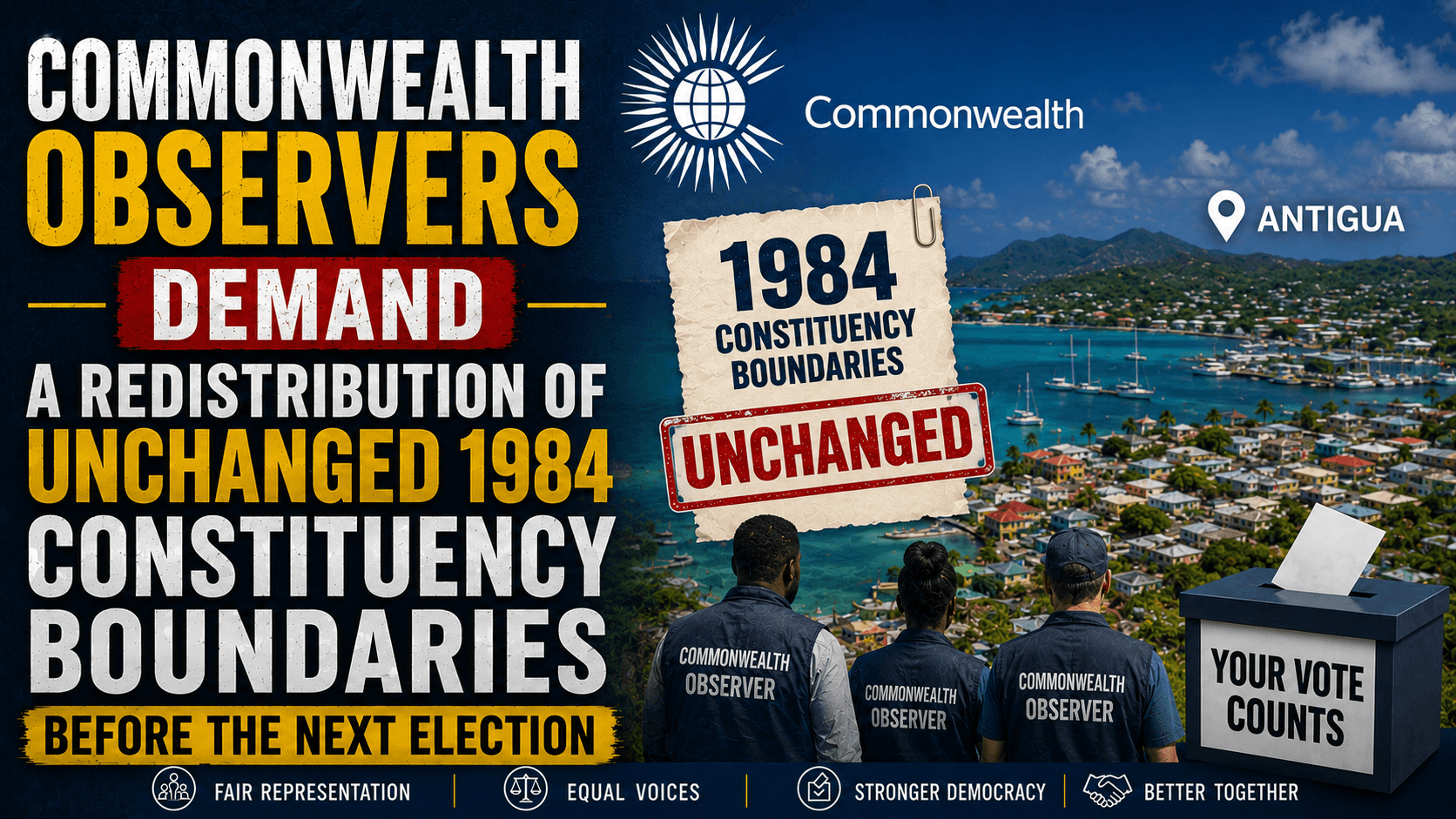
International election observers have issued their strongest warning yet about the state of Antigua and Barbuda’s electoral map, calling for urgent and independent redistribution of constituency boundaries that have remained fundamentally unchanged for over four decades — a situation they say threatens the foundational democratic principle of one person, one vote.
Boundaries Frozen Since 1984
The Commonwealth Observer Group to the April 30, 2026 general elections released its final report calling for urgent reform of constituency boundaries, while commending the overall peaceful and transparent conduct of the polls. The group reiterated concerns first raised by the 2023 Commonwealth Observer Group regarding constituency boundary delineation, noting that electoral boundaries have remained largely unchanged since 1984 despite significant demographic change.
The implication is stark: Antigua and Barbuda has held multiple elections using a constituency map drawn when the nation’s population, settlement patterns, and demographic distribution looked entirely different from today. Over forty years, communities have grown, shifted, and transformed — but the electoral boundaries carving them into political units have not kept pace.
The Principle at Stake
The Group warned that disparities in voter numbers across constituencies risk undermining the principle of equal suffrage and could affect public confidence in the electoral process. It recommended that the government urgently empower the Boundaries Commission to undertake an independent, data-driven redistribution of seats based on the 2022 to 2026 census data, stressing that the process should be conducted free from political influence to ensure fairness and uphold the principle of one person, one vote.
When constituency populations are significantly unequal — with some seats containing far more voters than others — votes in smaller constituencies carry proportionally more weight than those in larger ones. This creates a structural inequality in representation that no amount of good electoral administration can correct at the polling station level. The fix must happen upstream, in the drawing of boundaries themselves.
A Credible Election — But Structural Reform Needed
The Observer Group, constituted by Commonwealth Secretary-General the Hon. Shirley Botchwey following an invitation from the Government of Antigua and Barbuda, was led by former Botswana Minister of Foreign Affairs Hon Pelonomi Venson and comprised four eminent persons from across the Commonwealth.