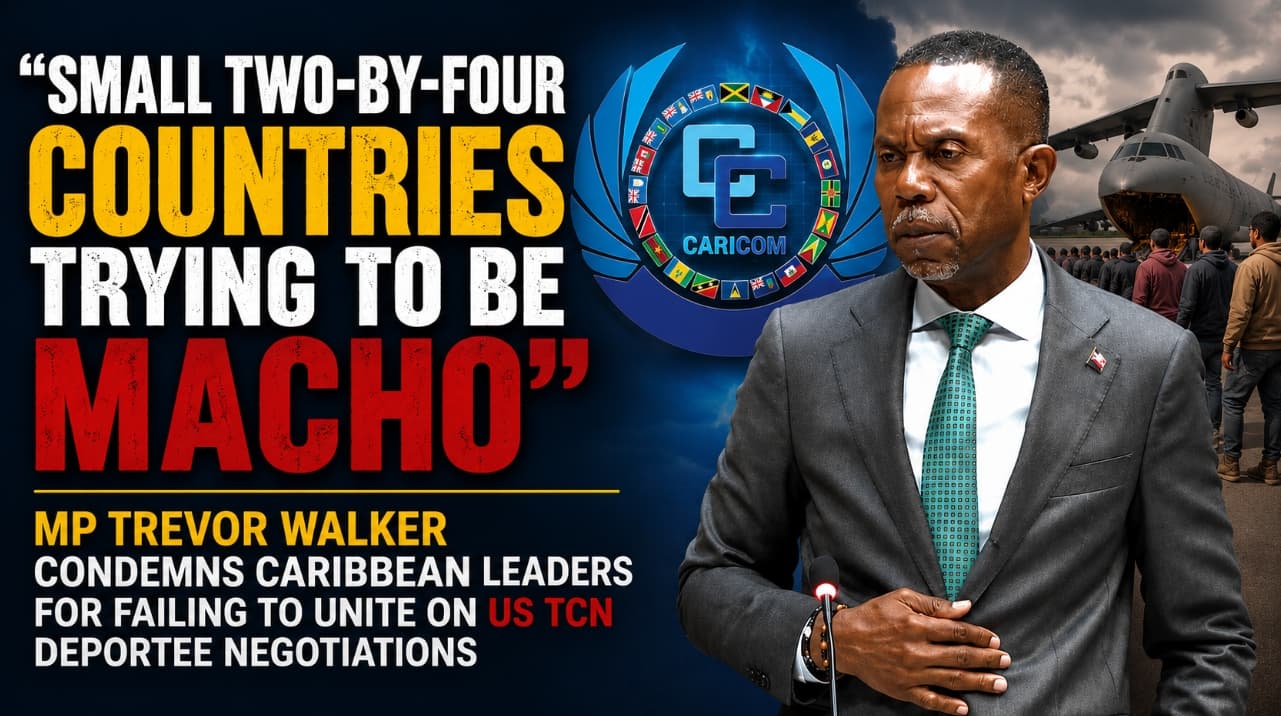
Barbuda MP Trevor Walker has delivered a scathing rebuke of Caribbean leaders for negotiating individually with the United States on the third-country deportee issue instead of presenting a unified regional position — warning Parliament that the fragmentation has left every small island state vulnerable and exposed, negotiating alone against a superpower with nothing to offer but compliance.
MP Walker’s criticism, delivered during Monday’s parliamentary debate on the White Paper resolution, targeted not only the Browne administration but the entire current generation of Caribbean leadership — accusing them of prioritising personal political interests over the collective survival of the region’s people.
“Not Even the Box the Cards Came In”
MP Walker framed the Caribbean’s failure to unite in the starkest possible terms, extending his now-famous “no cards” metaphor to encompass the entire CARICOM community.
“Here you are, these small two-by-four countries, trying to be macho — some of them trying to be macho — without cards, or even the box that the cards came in, putting our people in a precarious situation,” he told the House.
The image was deliberately humiliating — and deliberately accurate. Individual OECS and CARICOM nations negotiating bilaterally with the United States on the deportee issue hold very little strategic leverage, no economic weight, and no diplomatic muscle that Washington is obliged to respect. A unified CARICOM member states bloc — representing some 18 million people, a shared maritime space, and a collective diplomatic voice — would not have transformed the power asymmetry overnight, but it would have given the region something it currently lacks entirely: a negotiating position that would be more difficult for the United States to ignore.
Instead, as MP Walker pointed out, each country has gone its own way. Jamaica signed an MOU accepting up to 25 deportees every two weeks. St. Kitts and Nevis has accepted individuals. Dominica, Grenada and Belize all previously announced their own bilateral agreements with the US to accept the TCN (third-country nationals) deportees. Antigua and Barbuda is negotiating its own terms. And no two countries are operating from the same playbook.
CARICOM Met — and Said Nothing
MP Walker expressed disbelief that the recently concluded CARICOM Heads of Government meeting in St. Lucia — attended by the Prime Minister and regional leaders from across the Caribbean — failed to produce any collective position on the deportee issue whatsoever.
“You had a CARICOM meeting, which ended recently, and at no time have you heard CARICOM discuss this issue as a major Caribbean issue to be confronted as to how they’re going to deal with this situation,” MP Walker said.
He contrasted what CARICOM chose to spend its time on with what it chose to ignore. “What you’re hearing them talking about is the office of the Secretary General and the dispute between who don’t want and who wants the Secretary General. But they’ve all taken individual positions as regional leaders, instead of taking a collective position [on the TCN deportees] and to discuss the matter collectively.”
The comparison was pointed. CARICOM found the institutional bandwidth to refer a dispute over the reappointment of Secretary-General Dr. Carla Barnett to the Caribbean Court of Justice for an advisory opinion — marshalling the full diplomatic and legal machinery of CARICOM to resolve an internal governance question. But on the matter of the United States pressuring multiple Caribbean nations to accept deportees described by Secretary of State Marco Rubio as “the most despicable human beings... perverts, pedophiles and child rapists,” CARICOM produced nothing.
“A Group of Arrogant Leaders”
MP Walker did not confine his criticism to the process. He challenged the character of the leadership itself.
“We have a group of arrogant leaders who are leading this Caribbean that are not about people, but about themselves, and the Caribbean ain’t gonna benefit with this crop of leaders,” he said.