Edition
Real News Antigua & Barbuda

“This MOU was given to them”: Senator Chester Hughes Suggests Government’s Capitulation Not Negotiation

Editorial Staff
Editorial StaffReal News Editorial Team
6 min read
ShareXFacebookWhatsApp
IMG_2033

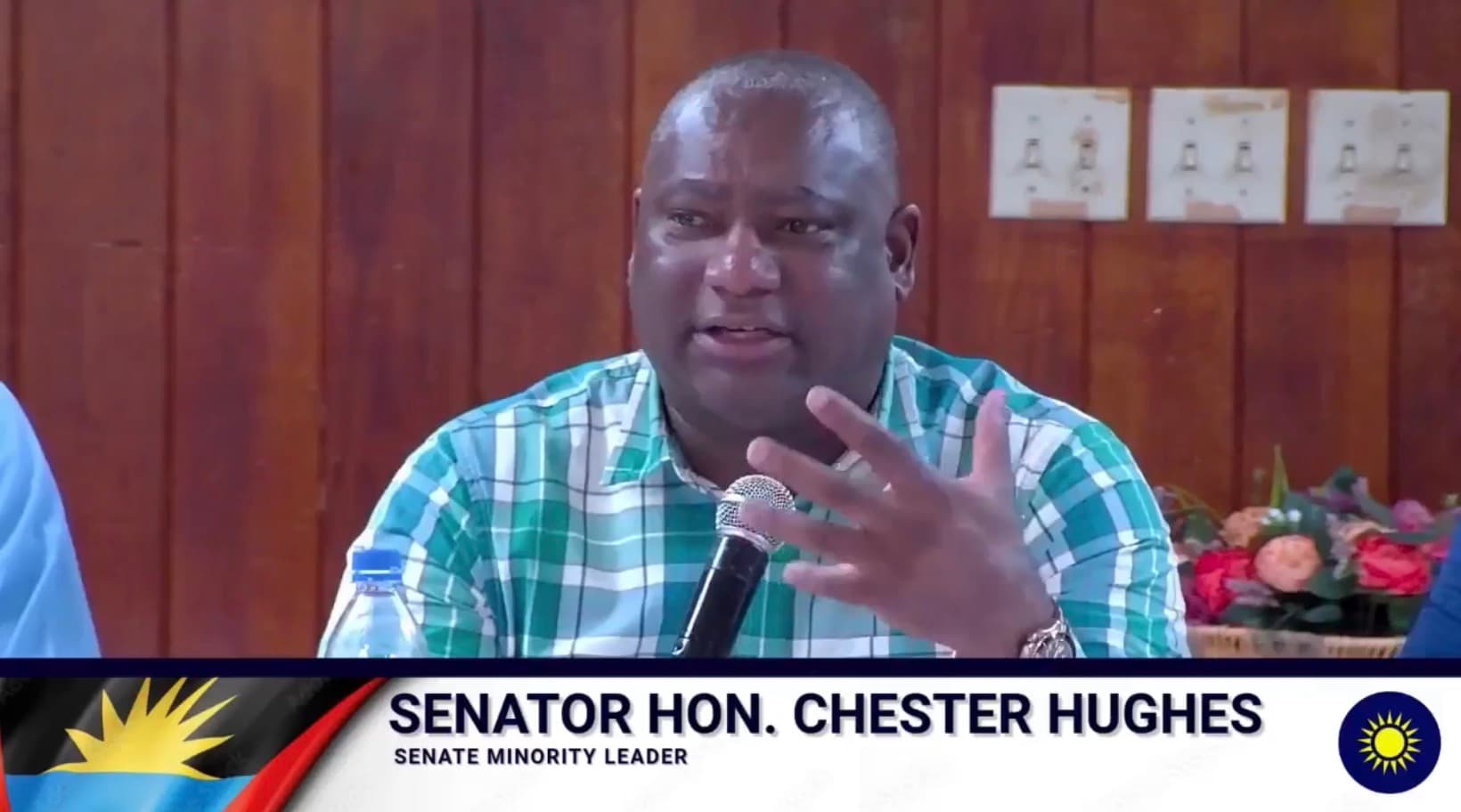
Senate Minority Leader and ABWU Deputy General Secretary Senator Chester Hughes delivered a scathing assessment of the government’s handling of the third-country deportee arrangement at Thursday night’s UPP town hall, warning the public that Prime Minister Browne’s posturing as a tough negotiator is fiction — and that the real questions of where deportees will live, how they will be contained, and what happens to Antigua’s already struggling labour market have not been answered.

Senator Hughes, who addressed the Moravian Conference Centre gathering in his dual capacity as a senator and a senior trade unionist, cut through what he described as the Prime Minister’s “fanciful” framing with a blunt assessment that drew applause from the audience.

“America Did Not Negotiate”

Senator Hughes rejected outright the government’s characterisation of the arrangement as a negotiated agreement between sovereign partners. “The government of Antigua and Barbuda negotiated a MOU,” he said. “This MOU, I believe, was given to them. No negotiations. They’re making it sound fancy. America did not negotiate with any of these governments. America told them you’re going to take these persons, and that’s it.”

He said the Prime Minister was “playing fanciful with words” and “trying to show a tough stance, as if he’s being a bad boy to America, but at the same time, every time you hear him speak, he says something different.”

Senator Hughes pointed to the shifting numbers as evidence. “First, the PM is not taking more than 10. Then recently, he’ll accept 16. America is going to send a jumbo jet here, and how much ever come on that plane is what he’s going to take. Let’s get that right first and foremost.”

“Where Are They Going to Live?”

The senator posed the most practical question the White Paper fails to address — one that cuts directly to the daily reality of every community in Antigua and Barbuda. “Where are these people going to stay? Booby Alley? Are they going over to Hodges Bay? Are they coming next to you out there, Creekside? Where are they going to live?”

The question is not hypothetical. Antigua and Barbuda is a small island with finite housing stock, a documented shortage of affordable accommodation, and communities already dealing with the pressures of a rising cost of living. The White Paper, Senator Hughes noted, offers no answer.

The Montserrat Precedent — and the OECS Problem

Senator Hughes drew a pointed historical parallel to the Montserrat volcanic crisis, when the UK government paid Antigua and Barbuda to resettle displaced Montserratians. “How many Montserratians stayed here? They all came and went to London,” he said — a reminder that physical placement in Antigua and Barbuda does not guarantee permanent residence, and that displaced populations with the means to move will move.

He then raised what he described as one of the most alarming gaps in the White Paper — the borderless nature of the OECS. “We have a borderless situation in the OECS. So while we’re talking about just the 14 for Antigua, what about the others who are in St. Kitts, St. Lucia, who are not comfortable there, but find out they can move once they have papers throughout the region?”

The implication is stark: deportees placed in any OECS territory with freedom of movement could end up anywhere in the sub-region, meaning Antigua and Barbuda may ultimately absorb not only its own allocation but individuals transferred to neighbouring states.

The Labour Market: “There Are People Out There Looking for Jobs”

Advertisement

Article mid


Drawing on his professional expertise as the ABWU’s Deputy General Secretary, Senator Hughes challenged the Prime Minister’s suggestion that the government would negotiate to receive skilled deportees who could improve Antigua’s labour market.

“I want to remind the Prime Minister that there are people who are out there looking for jobs also, and there are persons who have been applying all over the country but cannot get,” the senator said. “Are these persons that are going to be sent to Antigua going to work in the public service? Are they going to be placed at public works like the young people that they took on before the general elections, and told them to go home? After all, they’re waiting now — this is the fourth month to be paid.”

Senator Hughes noted that the government cannot credibly claim it is accepting deportees to fill labour market gaps when the Prime Minister himself admitted in Parliament that no recent labour market survey has been conducted and that his claim of “full employment” was based on anecdotes rather than data.

The Antigua Airways Warning

The senator invoked the Antigua Airways debacle as a cautionary tale about the government’s track record with arrangements involving the movement of foreign nationals. The Prime Minister had promised that the airline’s flights from West Africa would bring “wealthy people” and “high-end tourists,” and told Antiguans and Barbudans to prepare their Airbnbs for the spending that would follow.

“And then what happened to that disaster? Persons started to run from Antigua. Some died on a boat that sank. Bodies were washed up. They end up in Saint Thomas, they end up in America,” Hughes said. “And up until now, we have not had a report from this government as to the state of affairs, how these persons left Antigua, ended up in other territories, and it all went under the carpet.”

Where Is the Foreign Minister?

The senator closed by asking a question that several observers have raised quietly but the senator put on the public record. “Where is our Foreign Minister and his voice on this subject matter? We have heard our senior ambassador, I believe, spoke one time on the subject matter, and has gone completely silent.”

The silence of the Foreign Minister on one of the most consequential foreign policy decisions in Antigua and Barbuda’s recent history is a notable absence that the senator placed squarely before the public.

“Food Without Gravy”

Senator Hughes’ final assessment of the government’s White Paper was delivered with the economy of a man accustomed to industrial negotiations. “They have not come forward with any position to the public except to leave Antiguans and Barbudans hanging and talking about a white paper without giving the substance behind it,” he said. “It is like giving people food without gravy to eat.”

The UPP has confirmed that Thursday’s town hall was the first in a series of public consultations. The parliamentary sitting on the White Paper will be on Tuesday July 14th.

Comments

Leave a comment

Comments are moderated before appearing.

Weekly Digest

Stay ahead of every story that matters.

Every Monday morning — the week's most important news from Antigua & Barbuda and the Caribbean, delivered straight to your inbox.

  • Breaking news & top stories
  • Politics, crime, business & sport
  • Free — unsubscribe any time

No spam. One email per week. Unsubscribe any time.

or
Join our WhatsApp group

About the author

Editorial Staff
Editorial Staff

Real News Editorial Team

Real News Antigua and Barbuda editorial team.

Advertisement

Leaderboard ad

Related articles

Advertisement

M Banner
Join our WhatsApp