For months, Prime Minister Gaston Browne told the Antiguan and Barbudan public that his government was resisting United States pressure to accept third-country deportees — that the country was being "coerced," that he had drawn a firm red line, and that no agreement had been finalised. The impression created was of a government holding out against an unreasonable demand from a global superpower.
A government white paper now scheduled to be brought before Parliament during the week of July 13th tells a materially different story.
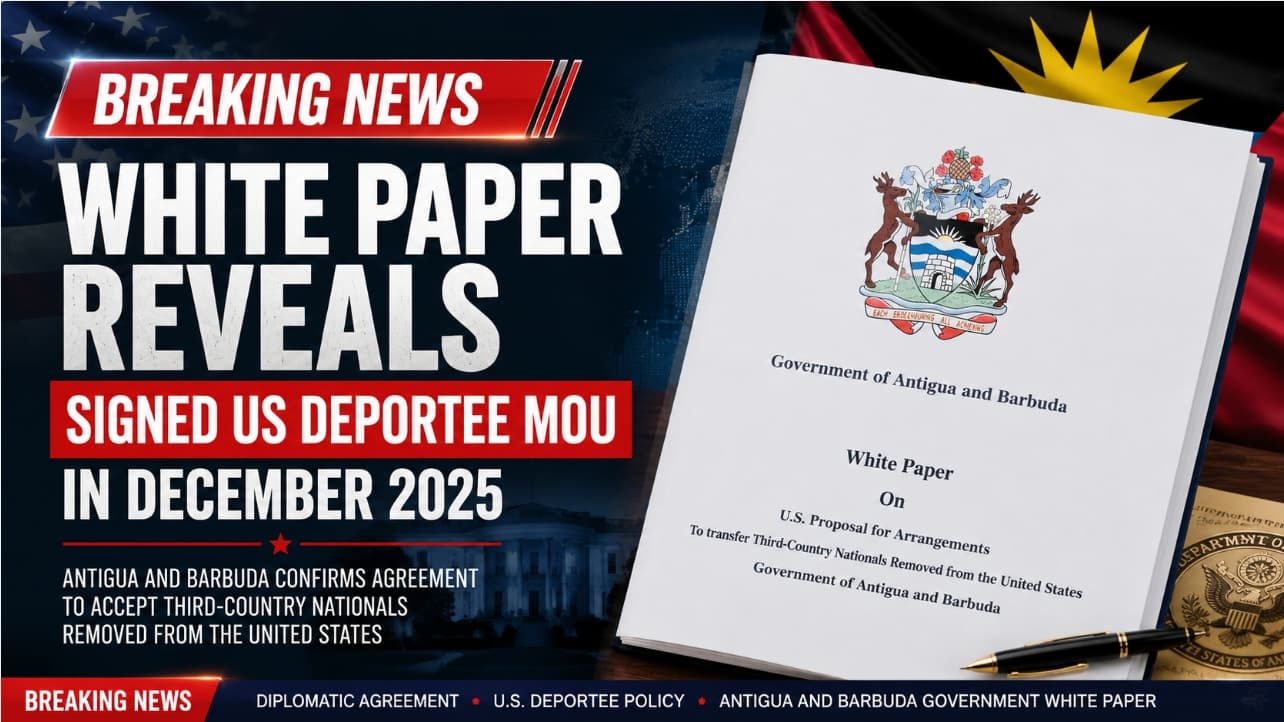
The document confirms that the Gaston Browne administration signed a Memorandum of Understanding with the United States government as far back as December 19, 2025, and that his administration has been actively negotiating the possible acceptance of up to ten third-country nationals in 2026 under specific conditions.
The MOU existed. It was signed. The public was not told.
What the White Paper Reveals
The government's own white paper, now headed to parliamentary debate, is a candid document in ways that the Prime Minister's public statements were not. It acknowledges a series of serious risks that the acceptance of third-country deportees would pose to Antigua and Barbuda — risks that were apparently being weighed internally while the public was being given a narrative of principled resistance.
Those risks, as admitted by the government's own document, include threats to national security and public safety; concerns about sovereignty and the potential loss of control over who enters and resides in the country; legal obligations under international law that may complicate the deportation of individuals once they are on Antiguan soil; healthcare costs associated with individuals who may arrive with medical needs; pressure on housing stock; and the potentially irreversible situation that arises if some individuals cannot be deported once they have been accepted.
The white paper also reveals a frank admission that the government feared refusing to cooperate with Washington could make Antigua and Barbuda appear "less cooperative" in the eyes of the US government — a concern that illuminates precisely the kind of pressure the Prime Minister acknowledged publicly only later, when he described the situation as "coercion."
A Timeline That Raises Serious Questions
The sequence of events matters enormously.
December 19, 2025: Antigua and Barbuda signs an MOU with the United States government on third-country deportees. The public was not informed.
June 22, 2026 — more than six months later: Prime Minister Browne, spoke at the OECS Authority opening ceremony in Deep Bay where he framed his government's position as a firm cap of ten per year and described the U.S. pressure as "coercion." He did not mention the MOU signed in December of 2025.
Days later, the government had already raised its stated willingness to accept between 14 and 16 individuals annually — a significant revision of the "firm" ten-person cap the Prime Minister had publicly declared.
And throughout all of this, the Prime Minister did not bring a single document, proposal, or signed agreement before Parliament for debate, review, or public scrutiny.