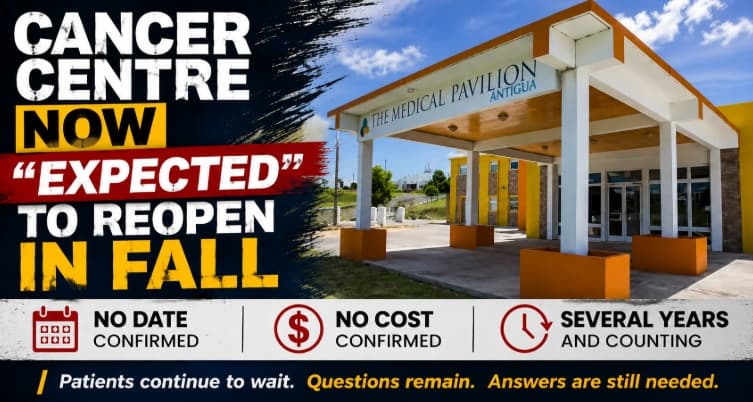
Another month, another vague timeline. Several years after the Cancer Centre Eastern Caribbean shut its doors, the government has once again offered Antiguans and Barbudans yet another promise without a date — telling the nation only that treatment services are now "expected" to resume sometime in the fall, with no confirmation of when patients can actually walk through the doors, and no answer on what it will cost them when they do. This promise of a fall opening comes after yet another failed promise when earlier this month the Minister of Health Michael Joseph stated the cancer Centre would open at the end of June 2026.
Yet Another Vague Timeline
Director General of Communications in the Prime Minister's Office, Maurice Merchant, told Thursday's post-Cabinet press briefing that the centre is expected to begin treatment services in the fall, once specialised equipment, staffing, and safety requirements are in place. He said a radiation oncologist, radiation physicist, and radiation therapist have been identified and are being integrated into the programme.
But once again, no specific opening date was given — extending a pattern of shifting and unfulfilled promises that has now stretched across several years. The fall timeline joins a long list of previous targets — weeks, then months, then "imminent," then specific budget-year promises — none of which materialised.
Patients Left in the Dark on Cost
Perhaps more troubling than the absence of a firm date is the government's continued silence on what cancer patients will actually have to pay once the centre does reopen. Asked directly whether services would be covered under the Medical Benefits Scheme and what patients could expect to pay, Merchant said those matters are "still under discussion." He said the government would continue to support people who require cancer treatment but offered no details on whether services will be fully covered, partially subsidised, or require out-of-pocket payments.
For a population that has spent several years watching cancer patients shoulder devastating costs to seek treatment abroad, this is not a minor administrative detail — it is the question that determines whether the reopened centre will actually be accessible to the ordinary Antiguan or Barbudan, or whether it will exist as a facility in name only for those who cannot afford to pay out of pocket.
The Devastating Cost of Going Abroad
While the government deliberates over pricing structures, the human and financial toll of the centre's prolonged closure continues to mount. For more than several years, Antiguan and Barbudan cancer patients have been forced to travel overseas — to Colombia, Trinidad, and Suriname — for treatment that should be available at home. Health Minister Michael Joseph himself recently disclosed that the government spent approximately €80,000 within a two-week period sending cardiac patients overseas, while a further US$200,000 was approved for cancer patients receiving treatment in Colombia alone — figures that represent only a fraction of the true cost once patients' own travel, accommodation, lost income, and family caregiving expenses are factored in.
For a family already grappling with a cancer diagnosis, the added burden of arranging international travel, securing accommodation in a foreign country, and financing treatment far from home and support networks has been a defining hardship of the centre's closure — one that wealthier patients can absorb, and one that has placed life-saving treatment further out of reach for everyone else.