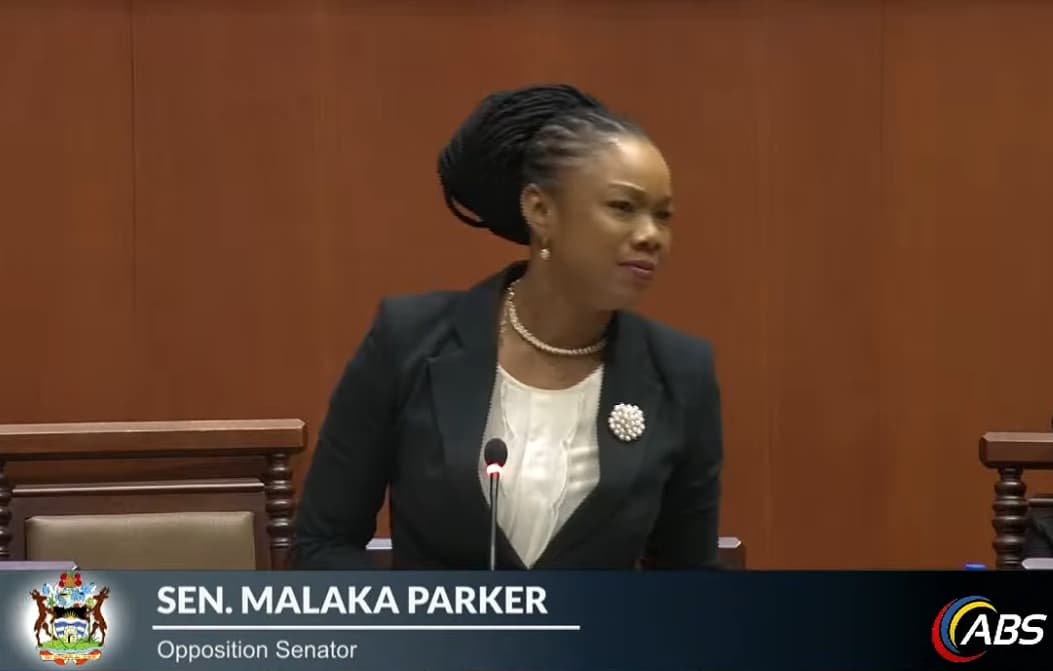
Opposition Senator Malaka Parker made clear from her first breath in Monday afternoon's Senate debate that she holds no sympathy for the gunmen terrorizing the nation. She then spent the balance of her contribution refusing to let the Firearms (Amendment) Bill 2026 stand in for the leadership she says the Antigua and Barbuda Labour Party (ABLP) 13-year government has failed to provide.
"I want to say from the outset, Madame President, I have no sympathy for any gun-wielding criminal within this two-by-four state of Antigua and Barbuda," the senator declared. "I hold no brief for anyone who would wish to do another citizen harm."
But context, she insisted, matters. "The circumstances under which we are meeting here today matter. And I want to say that the primary reason we are here is because I believe the Prime Minister had a point to prove," she charged, pointing to what she called an "unnecessary back and forth" that Prime Minister Gaston Browne "started with the judiciary, both local and abroad, because of careless blustering and language that was very inflammatory."
"That type of incendiary language and inflammatory positions — which, by the way, he continued and continues to double down on — should not be the context in which we are meeting to solve these types of issues," she said. "That's how I'm going to start."
The rebuke lands on well-documented ground: the Prime Minister told Parliament last month that there are "crooks and criminals" within the judiciary while conceding, under questioning from Opposition Leader Jamale Pringle, that he has "no evidence to send to anyone" to support the claim.
Where She Agrees
Senator Parker was careful to separate the bill's content from its genesis. "Now, this piece of legislation does a number of things, and I can't say that I disagree with all of them. There are many areas in which I find complete support in terms of what is intended," she told the chamber.
Nor did she dispute the crisis the bill answers. "We may not have exact data and figures, but we have enough anecdotal evidence, Madame President, to see that violent crime, particularly gun-related crime, is on the rise," she said, noting that the testimonies of colleagues across the chamber showed that "none of us has escaped the long reach of the criminal apparatus in this country. Myself included." Her conclusion: "We can all testify to that, and we need action, Madame President."
Crime, she argued, should be the one issue above the fray. "Crime in a small, intimate society like ours in Antigua and Barbuda is supposed to unite us... because I believe we know that crime has no colour," she said — a sentiment that placed her alongside Barbuda MP Trevor Walker, who told the Lower House that crime "has no colour, has no religion" when the bill passed there on 28 September.
Government's Failure in Prevention and Investigation
What Senator Parker would not accept is the framing that lays the crime wave at the judiciary's feet. "This rise in violent crime did not happen overnight," she said. "The numbers were there and the trends were there. And we know that the uptick in gang activity amongst our youth was there. All of it was there and so was this administration, for 13 years of that crawl and that creep. We must also pull the files and the record and examine what has been done and what has not been done, and what would have been the priority areas for this government."