Edition
Real News Antigua & Barbuda

Senator Ashworth Azille Warns Against Viewing Harsher Sentences as the "Single Bullet" to End Gun Crimes

Editorial Staff
Editorial StaffReal News Editorial Team
4 min read
ShareXFacebookWhatsApp
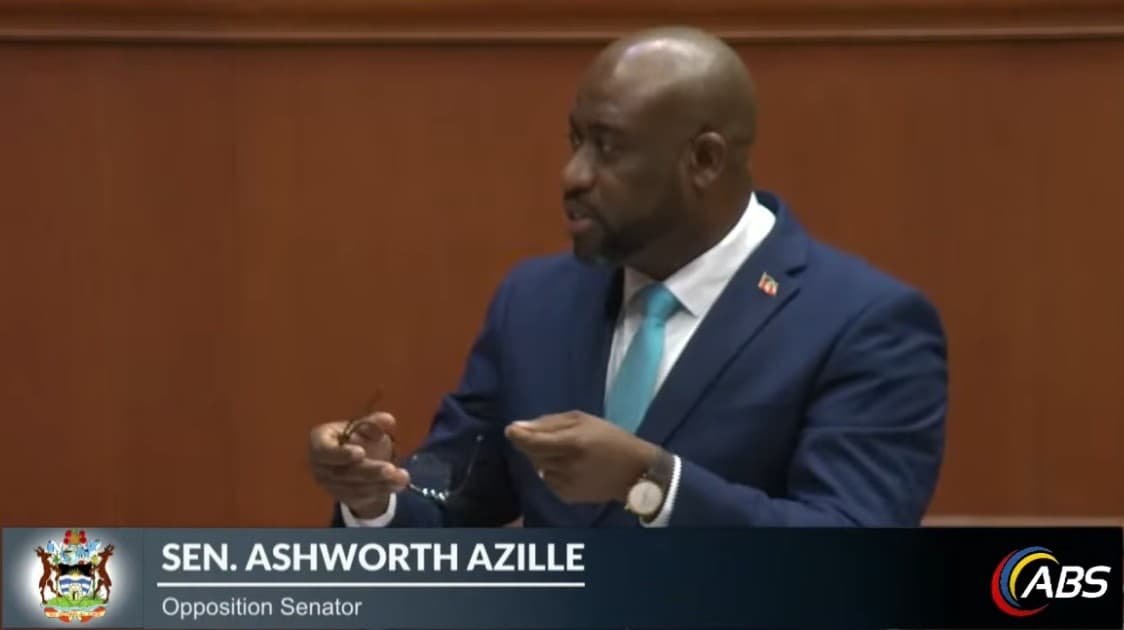
Ashworth Azille talking in parliament in blue suit and light blue tie with abs name tag and logo

Opposition Senator Ashworth Azille supported several of the tougher penalties in the Firearms (Amendment) Bill 2026 when the Senate took up the measure on Monday morning, but he spent much of his contribution warning that mandatory minimum sentences, on their own, will not rescue a nation he says is "living under a state of fear."

"I want to declare, Madame President, that I am wholly in support of giving lengthier sentences to persons who are guilty of gun crimes," the United Progressive Party (UPP) senator and educator told the Upper House, before adding the caveat that framed his entire presentation: "We are not looking for a single bullet to solve the issue of crime, because this piece of legislation alone cannot guarantee us that we will have a reduction in gun crimes going forward."

The bill introduces mandatory minimum sentences for a range of firearm offences, including unlicensed possession, carrying guns in prescribed public places, and selling, transferring or importing firearms and ammunition.

Senator Azille agreed that the moment demands extraordinary action. "I agree that this Firearm (Amendment) Bill 2026 is coming at a time when the people of Antigua and Barbuda are admittedly living under a state of fear," he said, with communities across the nation asking, "What can we do to be safer?" Senator Azille insisted that "promises and sound bites cannot be sufficient to make them feel safe enough."

"So yes, I agree that this is not an ordinary bill. This is an extraordinary one," he declared.

A Roll Call of Victims

In one of the morning's most sobering passages, the senator read from what he described as a summary of reported gun incidents between January and early September 2026: a 47-year-old homeowner shot in the abdomen by two masked gunmen during a home invasion in All Saints on 14 January; a 42-year-old man shot twice in the thigh on Parliament Street; Nikisha Rose, 42, killed on 23 January with a male companion wounded; Ashworth O'Brien found dead in Gray's Farm following a reported shooting on 10 March; teenagers Omari Lewis and Briana Clark, both fatally shot on 26 March; four young males aged 17 to 20 shot by unknown assailants; a masked gunman firing through a vehicle window on Dickenson Bay Street while occupants sat inside; and daytime armed hold-ups at two service stations.

"They're no longer small arms — they're utilizing very large weapons," he said of the service-station robberies, agreeing with Senator Govia's earlier observation that "it is no longer a case... where many of these perpetrators are simply coming to rob. They're coming to rob and kill. And so, the question is: why do they feel so emboldened?"



Advertisement

Article mid


The deaths, he insisted, must never be filed away as data points. "Beyond that incident of crime, there is a family, there's a mother, there's a child, there's an aunt who's languishing at home suffering for the loss of a loved one. And so, we must humanize them," he said, before asking the chamber to observe a moment of silence for the victims, a request President Alincia Williams-Grant deferred to the end of the debate on the bill.

Imprisonment Not a Sufficient deterrent

For Senator Azille, the analytical heart of the debate is a single question: "whether the amendments alone as proposed — stiffer maximum sentences and minimum sentences — will remedy the proliferation of gun crimes that we've seen in the recent past."

His answer was blunt. "For many of our repeat offenders, it appears that the threat of imprisonment is not a deterrent," he argued. "They have demonstrated that when they are hellbent on committing an action... they are going to do it anyway."

That, he said, is why governments must resist legislating by reflex: "We tend to do the knee-jerk reaction thing to a lot of the issues that we face in society. We tend to make these pocket-size decisions that, yes, may move the needle to some degree, but it fails to truly address the broader issue."

And he pushed back against the suggestion from the government benches that the opposition was politicising the crime wave: "This is not a political issue. I must suggest, Madam President, that this is a deep sociological issue and one that all of us must be concerned about."

The position closely tracks the one taken by Opposition Leader Jamale Pringle when the bill cleared the Lower House, where he cautioned that "this alone is not the saving grace of Antigua and Barbuda."

Comments

Leave a comment

Comments are moderated before appearing.

Weekly Digest

Stay ahead of every story that matters.

Every Monday morning — the week's most important news from Antigua & Barbuda and the Caribbean, delivered straight to your inbox.

  • ✓Breaking news & top stories
  • ✓Politics, crime, business & sport
  • ✓Free — unsubscribe any time

No spam. One email per week. Unsubscribe any time.

or
Join our WhatsApp group

About the author

Editorial Staff
Editorial Staff

Real News Editorial Team

Real News Antigua and Barbuda editorial team.

Advertisement

Leaderboard ad

Related articles

Advertisement

M Banner
Join our WhatsApp