Edition
Real News Antigua & Barbuda

“When — Not if — they Arrive, are they Free to Move to Montserrat? to St. Kitts?”: MP Trevor Walker Raises Concerns with Possible TCN Deportees' Freedom of Movement within OECS

Editorial Staff
Editorial StaffReal News Editorial Team
5 min read
ShareXFacebookWhatsApp
trevor walker questions feedom of movement of tcn deportees in oecs

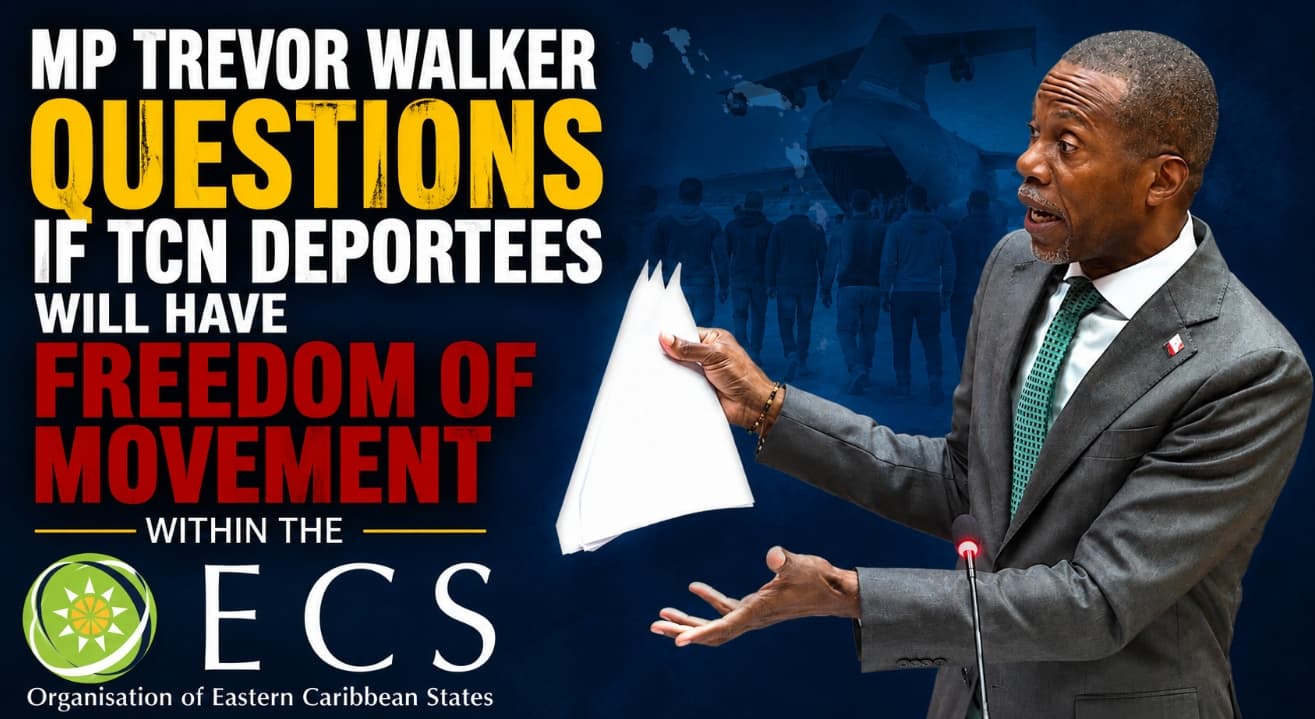
Barbuda MP Trevor Walker has placed before Parliament a question that neither the government’s white paper, the Prime Minister’s public statements, nor any OECS or CARICOM communiqué has addressed — and it may be the most consequential unanswered question in the entire third-country deportee debate.

If deportees transferred from the United States are given legal status in Antigua and Barbuda, does the OECS freedom of movement framework entitle them to travel freely across the sub-region?

“When — not if — when Antigua and Barbuda finalises this arrangement, and we would have gotten some of these deportees, are they free to move around the OECS?” MP Walker asked the House on Tuesday. “Are they free to travel from Antigua and Barbuda to Montserrat? Do they have that legal status to go to St. Kitts and Nevis if they want? We need to know.”

The government did not answer.

The Legal Reality MP Walker Identified

MP Walker’s question is not speculative. It is grounded in the existing legal architecture of the OECS, under which nationals and legal residents of member states enjoy freedom of movement across the sub-region. The OECS, governed by the Revised Treaty of Basseterre, provides for the free movement of people among member states — a framework designed to facilitate regional integration, labour mobility, and economic cooperation.

If a deportee transferred from the United States to Antigua and Barbuda is granted any form of legal status — whether residency, work authorisation, or some other documented standing — the question of whether that status automatically confers the right to move freely to Dominica, St. Kitts and Nevis, St. Lucia, Grenada, St. Vincent and the Grenadines, or Montserrat is not a hypothetical. It is a live legal question with immediate practical consequences for every OECS member state.

MP Walker made the point with characteristic directness. “So, we have a borderless situation in the OECS. So, while we’re talking about just the 14 for Antigua, what about the others who are in St. Kitts, St. Lucia, who are not comfortable there, but find out they can move throughout the sub-region once they have papers?”

The Flow Goes Both Ways

MP Walker’s framing revealed a dimension of the deportee issue that has not been at the forefront of the public discussion. The debate in Antigua and Barbuda has focused primarily on how many individuals this country might accept — ten, fourteen, sixteen — and on the background of these third-country deportees. But the OECS freedom of movement framework means the question is not just how many Antigua and Barbuda accepts. It is how many the entire sub-region accepts collectively, and whether any of them can subsequently relocate to Antigua and Barbuda from a neighbouring territory.

If St. Kitts accepts deportees and grants them legal status, can those individuals board a ferry or a flight and arrive in Antigua? If Dominica or St. Lucia accepts individuals under their own bilateral arrangements with Washington, do those individuals acquire the right to move freely across the OECS — including to Antigua and Barbuda?

The white paper is silent on this. The resolution passed by Parliament on Tuesday is silent on it. The Prime Minister’s extensive remarks to the House did not address it. CARICOM’s recently concluded Heads of Government meeting in St. Lucia produced no collective position on the deportee issue — let alone a coordinated approach to managing freedom of movement implications across the region.


Advertisement

Article mid


Constitutional Protections Upon Arrival

MP Walker went further, raising a constitutional point that compounds the freedom of movement question. Under the constitution of Antigua and Barbuda, any person present in the country — regardless of nationality or the circumstances of their arrival — enjoys fundamental rights and freedoms. These include protection of personal liberty, protection from discrimination, and freedom of movement within the state.

“One must understand,” MP Walker told the House, “When — not if — they arrive here, they have full constitutional rights like anybody else.”

The implication is that once deportees are physically present in Antigua and Barbuda, the constitution provides them with protections that may make their subsequent removal, detention, or restriction of movement legally complex — particularly in the absence of statelessness legislation and a standalone refugee act — the government's own white paper mentioned concerns over the legal ambiguity due to the absence of the previously mentioned legislation.

A deportee who arrives with legal status has constitutional protections. A deportee who arrives with legal status in a borderless OECS has constitutional protections and freedom of movement across multiple sovereign territories. And a deportee who cannot be returned to their country of origin or sent back to the United States — the “legal trap” that Opposition Leader Pringle previously highlighted from the white paper’s own text — becomes a person with constitutional rights, regional mobility, and no mechanism for removal.

A Question that should have been answered Before Any MOU was Signed

The freedom of movement question is not one that can be addressed after the fact. It needed to be resolved before the MOU was signed on December 19th, 2025. It needed to be raised at the OECS Authority meeting. It needed to be on the agenda at the CARICOM Heads of Government summit in St. Lucia. And it needed to be answered before Parliament was asked to approve the principles governing Antigua and Barbuda’s continued negotiations with the United States.

None of that happened.

MP Walker asked the question on the floor of Parliament. The government had the opportunity to answer. It did not. The resolution was passed regardless — with the freedom of movement implications for every OECS member state left entirely unaddressed.

For the people of Antigua and Barbuda — and for the people of every OECS territory whose borders are open to anyone with legal status in a neighbouring state — the question MP Walker asked on Tuesday remains exactly where he left it: unanswered, unresolved, and deeply alarming.

Comments

Leave a comment

Comments are moderated before appearing.

Weekly Digest

Stay ahead of every story that matters.

Every Monday morning — the week's most important news from Antigua & Barbuda and the Caribbean, delivered straight to your inbox.

  • Breaking news & top stories
  • Politics, crime, business & sport
  • Free — unsubscribe any time

No spam. One email per week. Unsubscribe any time.

or
Join our WhatsApp group

About the author

Editorial Staff
Editorial Staff

Real News Editorial Team

Real News Antigua and Barbuda editorial team.

Advertisement

Leaderboard ad

Related articles

Advertisement

M Banner
Join our WhatsApp