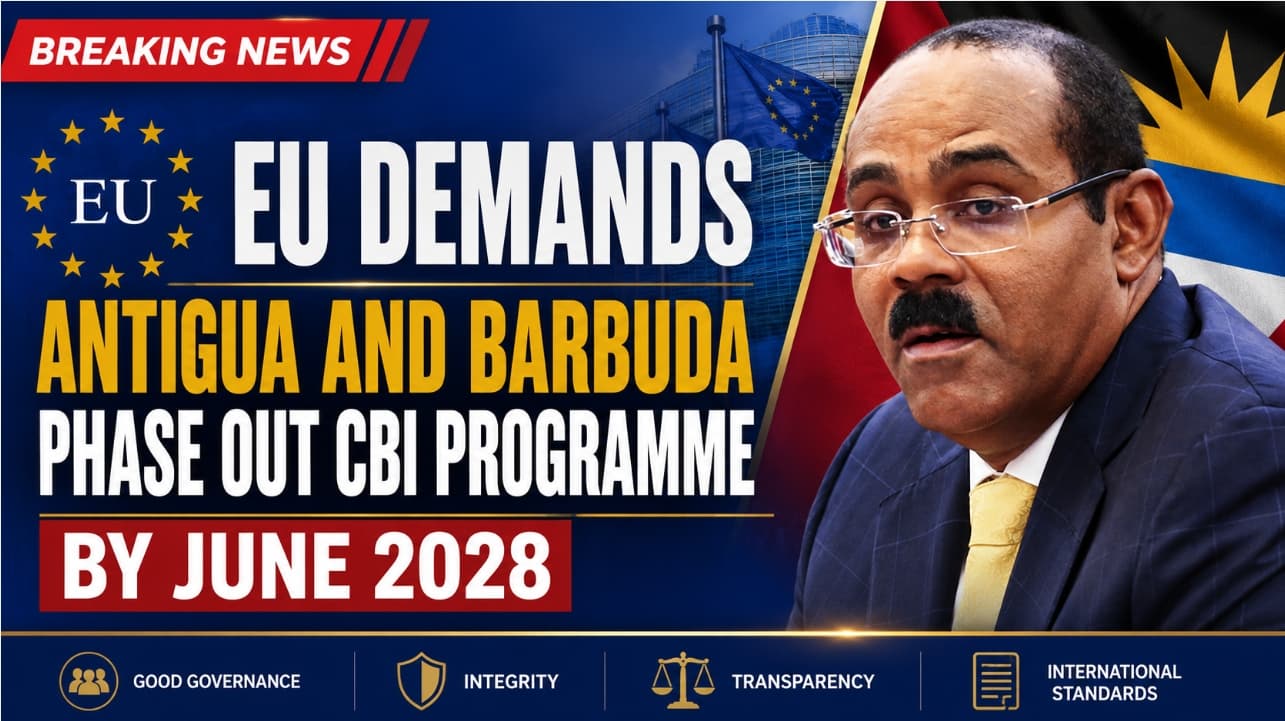
The confrontation between the European Union and the Caribbean's citizenship by investment nations has escalated from threat to formal demand — with the European Commission writing to Antigua and Barbuda to request the complete phase-out of its Citizenship by Investment Programme by June 1, 2028, and the Browne administration responding that it will not comply without viable replacement revenues.
The standoff sets up what may become the defining economic and diplomatic battle of Antigua and Barbuda's fourth-term government — with hundreds of millions of dollars in national revenue, visa-free access to Europe for every Antiguan and Barbudan passport holder, and fundamental questions of sovereignty all on the table simultaneously.
What the EU Has Demanded
The request was outlined in a formal letter from the European Commission, citing changes to the EU's revised Visa Suspension Mechanism — the legal framework through which Brussels can suspend visa-free Schengen access for third countries whose policies it deems to present migration or security risks.
The letter calls for the phase-out of the CBI Programme by June 1, 2028. In the interim, it demands strengthened vetting procedures and the continued exclusion of individuals subject to EU restrictive measures by September 2026.
Antigua and Barbuda is not alone in receiving the demand. Similar letters have been sent to Dominica, Grenada, St. Kitts and Nevis, and Saint Lucia — the five Eastern Caribbean nations operating citizenship by investment programmes, and the same five that recently established the Eastern Caribbean Citizenship by Investment Regulatory Authority in an effort to address exactly the concerns the EU has now escalated.
The Government's Response: No Unilateral Phase-Out
The Government of Antigua and Barbuda's response, issued Monday, was firm. The CBI Programme, it said, remains a critical pillar of the country's non-tax revenue, having financed hospitals, schools, infrastructure projects, and disaster recovery over more than a decade of operation.
Prime Minister Gaston Browne has maintained that the programme will continue and that Antigua and Barbuda will not agree to a unilateral phase-out without viable, concrete, and credible replacement revenues.
Significantly, government officials noted that the EU's proposed development support has not been quantified or presented as a direct replacement for CBI income — a pointed observation that Brussels is asking a small island state to surrender one of its largest revenue streams in exchange for assistance that remains, at this stage, entirely undefined.
The Government says it will continue engaging the European Commission through diplomatic dialogue while reinforcing due diligence measures and safeguarding the country's economic interests.
A Position Browne Staked Out Before the Letter Arrived
The formal EU demand crystallises a confrontation the Prime Minister had previously disclosed was brewing. Speaking on his radio programme in late June, Browne declared that Antigua and Barbuda would maintain the programme regardless of European action. "With or without those visa-free arrangements, our CIP programme continues. It is too important a source of non-tax revenue to give it up," he said at the time.
Browne has consistently argued that the Caribbean is being unfairly targeted, noting that wealthy individuals can often obtain European visas directly on the strength of their financial standing, and that no immigration programme anywhere in the world — including those in the United States, Canada, and Europe itself — is completely foolproof. He has also defended the programme's administration, stating that in twelve years in office he has never intervened to approve a citizenship application rejected by the Citizenship by Investment Unit.