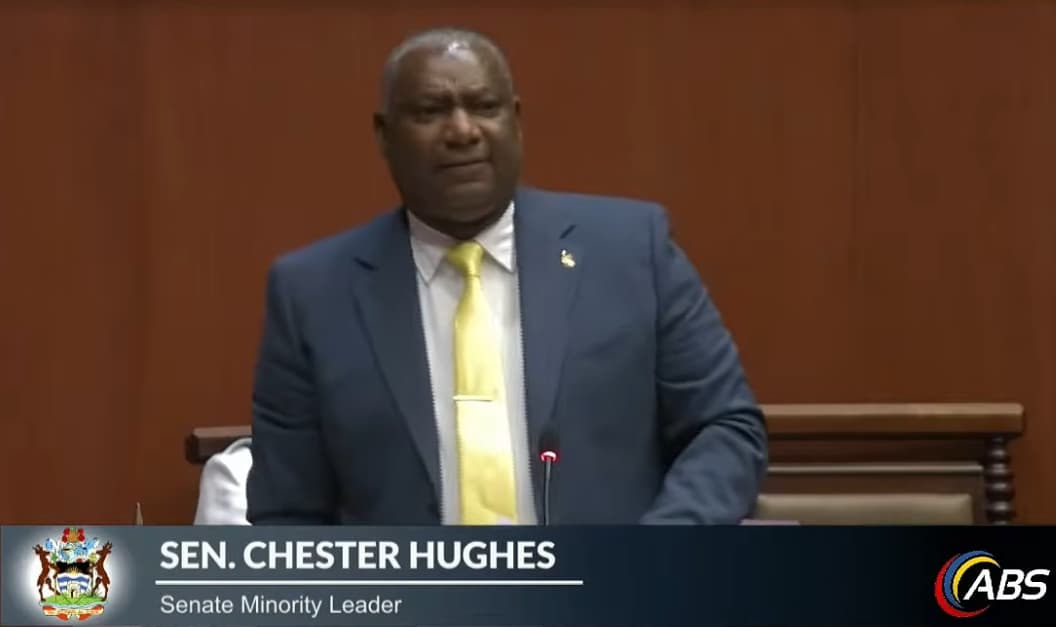
Minority Leader Senator Chester Hughes turned the Firearms (Amendment) Bill's own explanatory memorandum against it in Monday afternoon's Senate debate, arguing that a law which mandates a 15-year minimum while simultaneously empowering the Court of Appeal to go below it concedes, in its own text, that mandatory sentencing is the wrong instrument.
He prefaced the argument with an unsparing assessment of the benches opposite. "I listened to all of the senators, especially those on the government bench, and I said, you know, there's a deficiency there. They're qualified in everything except law, and they do not understand how the legal system works," the Minority Leader said.
The misunderstanding, as he framed it, begins with the separation of powers: "At the end of the day, the courts are separate [from] the parliament, [which is] separate [from] the executive. This is the legislative. We come here. We make laws. We don't interfere in judicial matters. The judiciary deals with the whole interpretation of the laws."
Reading the Bill's Own Words
Senator Hughes then read directly from the bill's explanatory memorandum: the Court of Appeal "may, if it determines that the imposition of the prescribed minimum penalty would be manifestly excessive and unjust, impose a sentence that is below the prescribed minimum."
"That's what it says. I don't know if I'm reading different, Madame President and if there's an amendment that I didn't get," he remarked. "The same parliament is saying that the High Court must give you a minimum of 15 years. And if the Court of Appeal thinks that you should get less, they have the right to give you less."
The certificate mechanism, he argued, makes the contradiction explicit at the moment of sentencing. Ordinarily, he noted, "either party can appeal a decision if they feel that the judge imposed a sentence on them that is high or wrong, they appeal; if the DPP feels that the judge's sentence, as a prosecutor, is too low, he can appeal." But under this bill, "you know it's wrong from the start of sentencing... The judge is already accepting that it's wrong. So, the judge is giving you a certificate saying my hands are tied. Therefore, I am going to allow the appeal court to overturn my decision."
His reductio followed: "So the appeal court can say, 'Okay, they gave you 15. I'm going to give you one.' So if that happened the other day, why are we here? Why are we here? If the system is not broken, why are we here? Aren't we supposed to be here to strengthen the system?"
The reasoning aligned the Minority Leader with Senator Malaka Parker, who earlier branded the certificate mechanism "cowardly," and with Senator Ashworth Azille's morning-session question of whether the provision merely "delays the inevitable."
What Strengthening the System Looks Like
Senator Hughes was explicit that his quarrel is not with toughness but with the bill's theory of change. "This is not strengthening the system," he declared. "What this is doing is changing the penalty."